Too Late is a Lie: Remove Age from the Equation and See What Happens

I've been asking myself a question lately. What would happen if I simply stopped thinking about my age, removed it from the equation entirely, and just lived my life regardless?
Not as a motivational exercise. Not as the kind of thing you write on a Post-it note and stick to the bathroom mirror. As an actual experiment. A genuine attempt to catch myself every time I use age as a reason — for not starting something, not finishing something, not believing something is still possible — and remove it. See what's left.
Because here's what I've noticed. The thought that it's too late, or that I'm racing against some kind of virtual clock, is running more of my life than I'd like to admit. It shows up in big ways. What is the point of pouring everything into this brand, into finishing that second book, when the window for these things is surely closing? And it shows up in smaller, more insidious ways too. What's the point of getting seriously fit again, really fit, at this age? What's the point of wanting more — not just materially, though why not that too, but more in terms of experience, friendship, beauty, daily life? At some point, a voice says, you are supposed to stop wanting so much. You are supposed to begin the process of scaling back, accepting, winding down.
I have been, without realising it, asking permission from my own age.
The clock nobody gave you permission to start
Here is what that clock actually says, if you listen to it carefully. It says that certain things have a window, and that window is closing. It says that ambition at this age is faintly embarrassing, that wanting more is somehow greedy, that the sensible thing — the dignified thing — is to begin the process of editing your life down rather than building it up. It says this not loudly but persistently, in the background of almost every decision, like a radio left on in another room that you've stopped noticing but that is shaping your mood nonetheless.
And the insidious thing is that nobody actually gave you this clock. Nobody sat you down and said: here is the point at which your dreams have an expiry date. You absorbed it. From a culture that has very fixed ideas about what later life is supposed to look like, from images and narratives and a thousand small signals that told you the second half of life is about contraction rather than expansion. You took it on without questioning it. And now it runs in the background of everything.
I have been letting an imaginary clock, set by people who know nothing about my life, make my decisions for me. And I am done with it.
The girl in the dark disco
It was the end of term. I was driving home from school, already planning what I wanted to do with the two weeks ahead — some fun, and the dreams, pushed forward, because the dreams don't stop just because the diary fills up. An ordinary Friday. I'd been playing a playlist I made recently, old songs chosen deliberately, to remind myself of who I once was or who I am. And then Electric Avenue came on.
Before I could think about it, I was somewhere else entirely.
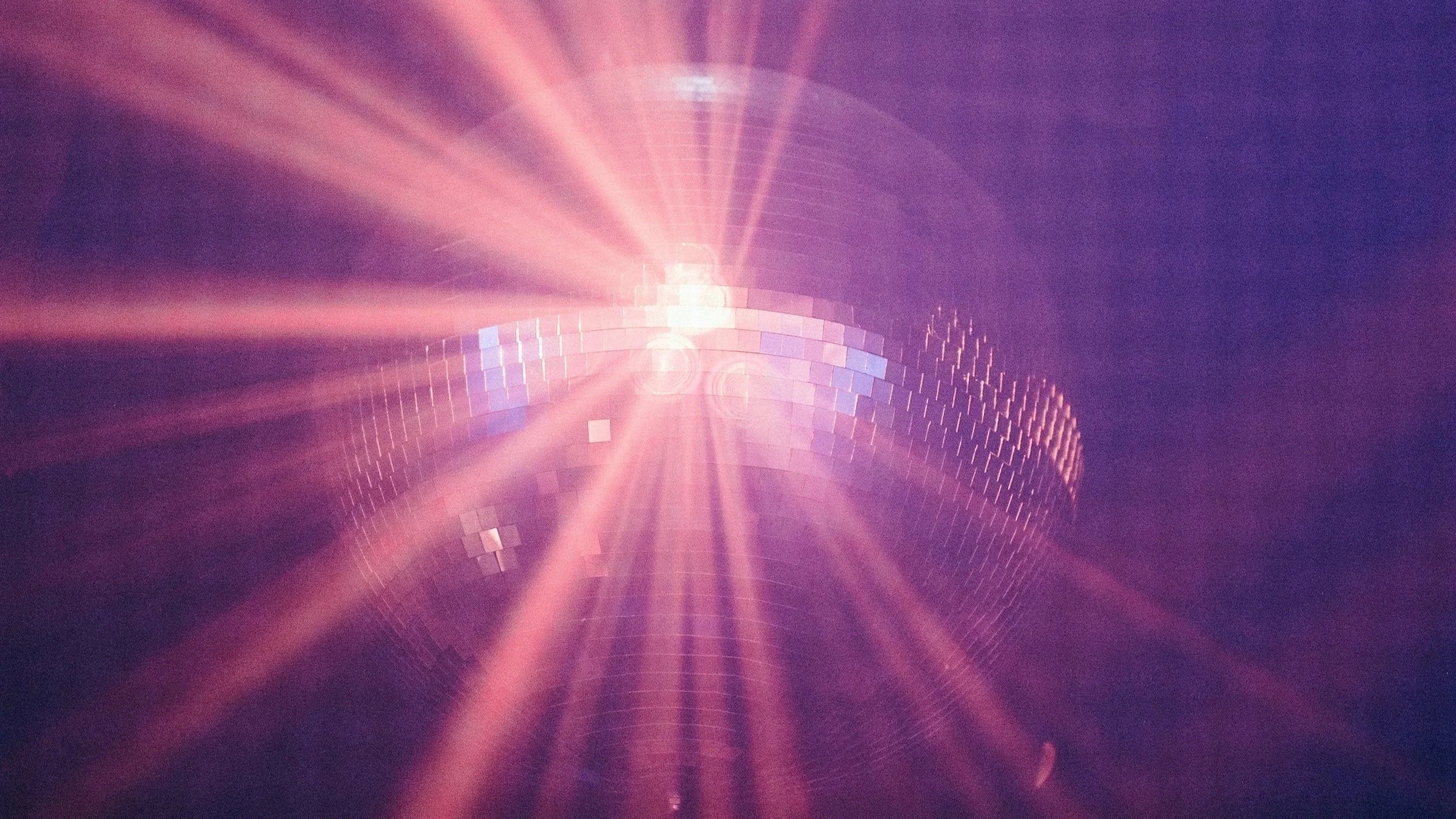
I was eighteen. My parents had just divorced and I had done what I apparently do when the ground falls away: I packed a bag and left. No plan, no permission, nobody knowing exactly where I was. I went to Cyprus, to stay with a friend from England who had made her life there, and for those weeks I was completely untethered and completely alive. Days in the cafes in the winter sun, the island stripped of its summer crowds, cold enough for a coat but bright enough to walk on the beach. They spoke to me in Greek and I answered in English, mostly, and somehow this struck nobody as particularly strange. I had no curfew, knew all the songs, knew all the dances, and had nowhere else to be. On a small island in winter, it turned out, it was simply cool to hang out with someone from London. People wanted to know me. They just weren't entirely sure what to make of me, which suited me perfectly. Evenings in a disco that was always, always dark — the kind of dark where you stop being visible in any particular way and you're just a body moving to music, present, anonymous, free.
I drove home through the traffic with Electric Avenue playing and I thought about that girl. Really thought about her. And I asked myself: is she gone? Is she actually dead, replaced by this more cautious, more realistic person who has learned to check with her age before she does anything?
Because she wasn't carefree, that girl. Her family had just broken apart. She didn't know what came next. She was slightly lost, slightly rebellious, and she went dancing anyway. She didn't remove the uncertainty or the loss or the not-knowing. She just refused to let any of it stop her.
I want to know when I stopped doing that.
The trap I spent years helping other people out of
Here is the irony that isn't lost on me. I trained in mindfulness over a decade ago. I worked with people living with cancer. I sat with people in bereavement. I went into schools and taught children how to live in the present moment, how to meet whatever was arising without immediately running from it or fighting it. I gave that teaching to hundreds of people who were facing things far harder than a birthday.
And somewhere along the way I forgot to give it to myself.
The reason we taught presence so insistently to people living with terminal illness or acute grief is not complicated. When the future looks the way it looks in those circumstances, you cannot live there. If you spend your days in an imagined future that is full of loss and ending and the unbearable, you will be overwhelmed. Fear will take over. Sadness will take over. The only bearable place, the only place where life is still actually happening, is now. Not as a philosophy. As a practical matter of survival.
What I hadn't fully seen until recently is that this is precisely what I had been doing with age. Not sitting with cancer, not sitting with fresh grief, but doing the same structural thing: living in an imagined future where it is already too late, where the clock has already won, where the story is already written. And letting that future make the present feel pointless.
The very trap I spent years helping other people out of.
Why presence gets harder as we age — and what we get wrong about it
This is where I want to say something that mindfulness teachers don't always say honestly: presence gets harder as we age. Not because we become less capable of it, but because the future becomes more concrete and more insistent. When you are thirty-five, living in the present moment is relatively easy. The future is largely abstract, largely positive, and it doesn't press on the present with much weight. When you are in your sixties, the future has acquired a different quality. It has shape and proximity. It reminds you of itself regularly, and not always gently.
And there is another trap here too, one I want to name because I think many of us have fallen into it. There is a version of present-moment awareness that tips, almost imperceptibly, into a kind of enforced acceptance. A pressure to be grateful, peaceful, at ease with how things are. To want less. To need less. To mistake resignation for equanimity. It can look like mindfulness from the outside while feeling, on the inside, like a slow dimming.
That is not what presence is. That is what presence gets distorted into when it meets a culture that has already decided you should be winding down.
Real presence, the kind I watched people find in the most difficult circumstances imaginable, is not passive. It is not soft. It is the decision to be fully alive in the only moment that actually exists, which means bringing your whole self to it, including your ambitions, your hunger, your refusal to be finished. The people I sat with who did this best were not serene. They were vivid. They were paying attention with an intensity that most of us only manage when we are forced to.
That is what I want to recover. Not serenity. Vividness.
The experiment
So here is my experiment.
I am going to remove the variable. Not permanently, not naively. I am not going to pretend I am twenty-five or that time is infinite. But I am going to try, for a sustained period, to catch every moment in which age is being used as a reason, and ask whether it is actually a reason or whether it is just an excuse. There's a difference. And most of the time, if we're honest, we know which one it is.
Thich Nhat Hanh, whose teachings I have returned to many times, used to suggest greeting difficult thoughts by name rather than fighting them. Hello, self-doubt, it's you again. Hello, fear, I see you there. Not to dismiss them but to recognise them, to stop them operating unseen, which is where they do their most damage. I am going to try doing that with this particular thought. Hello, age. There you are again, trying to be a reason. Let's have a look at whether you actually are one.
Because the past is gone and the future is not yet here. What we do in this moment, the decisions we make right now, shapes what comes next. That is not a cliché. That is precisely how it works. The girl in the dark disco in Cyprus understood this without knowing she understood it. She was eighteen and her world had cracked open and she went dancing anyway. She didn't wait for conditions to improve. She didn't ask permission. She just went.
I am not trying to be her again. I am not interested in going backwards. But I want to remember that she is not gone. She is, in some essential way, still the person making decisions in that car on an ordinary Friday, still planning the two weeks ahead, still reaching for more even when a voice says the window is closing.
Too late is a lie. It has always been a lie. And I am done letting it run my life.
Not sure where to start?
The Reading Map is twelve books for working out what the second half of your life is actually for — with a short note on what each one is good for, and when to read it. Free, and yours in a moment.