What Is Ikigai? The Real Blue Zone Lesson
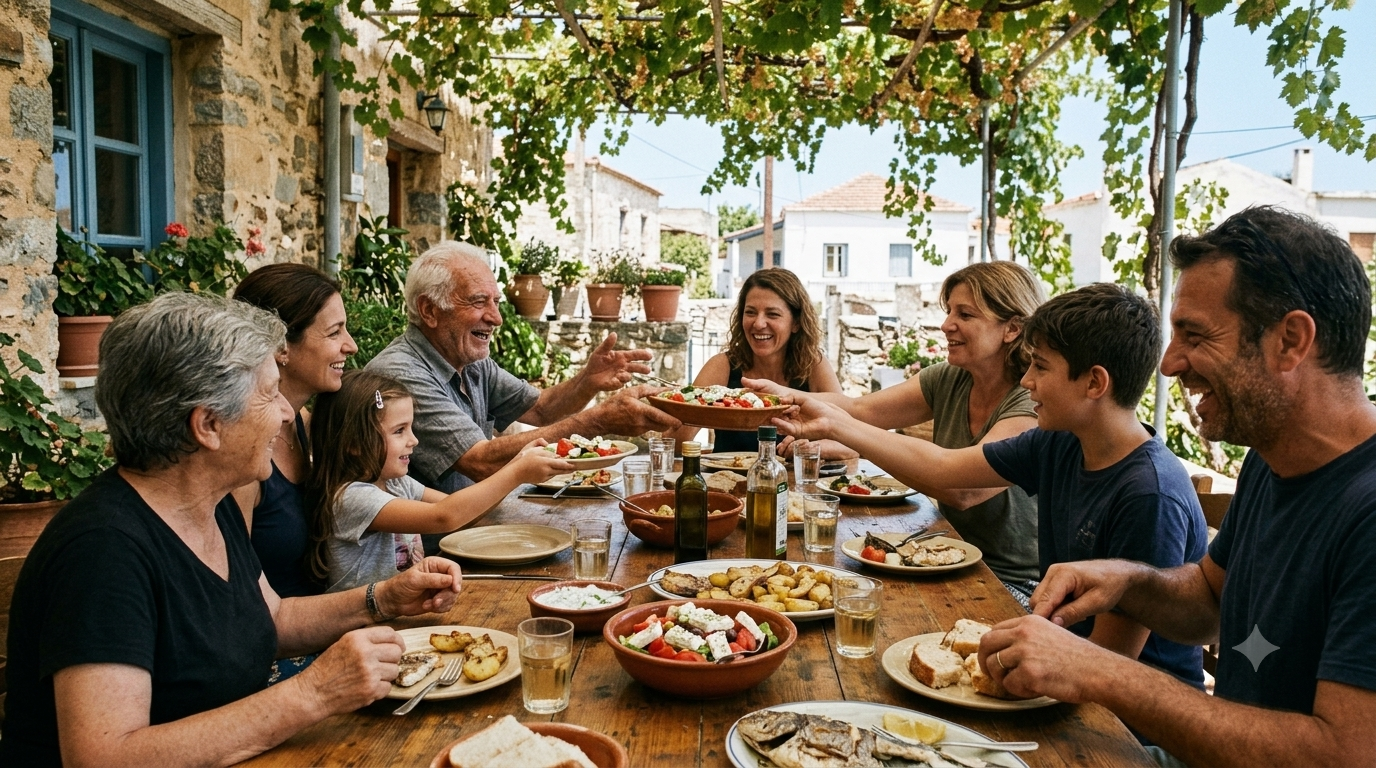
Last night I made dinner the way I learned to, in the Greek kitchens I grew up around. Nothing elaborate. Something slow on the stove, bread, a little wine, the table laid properly.
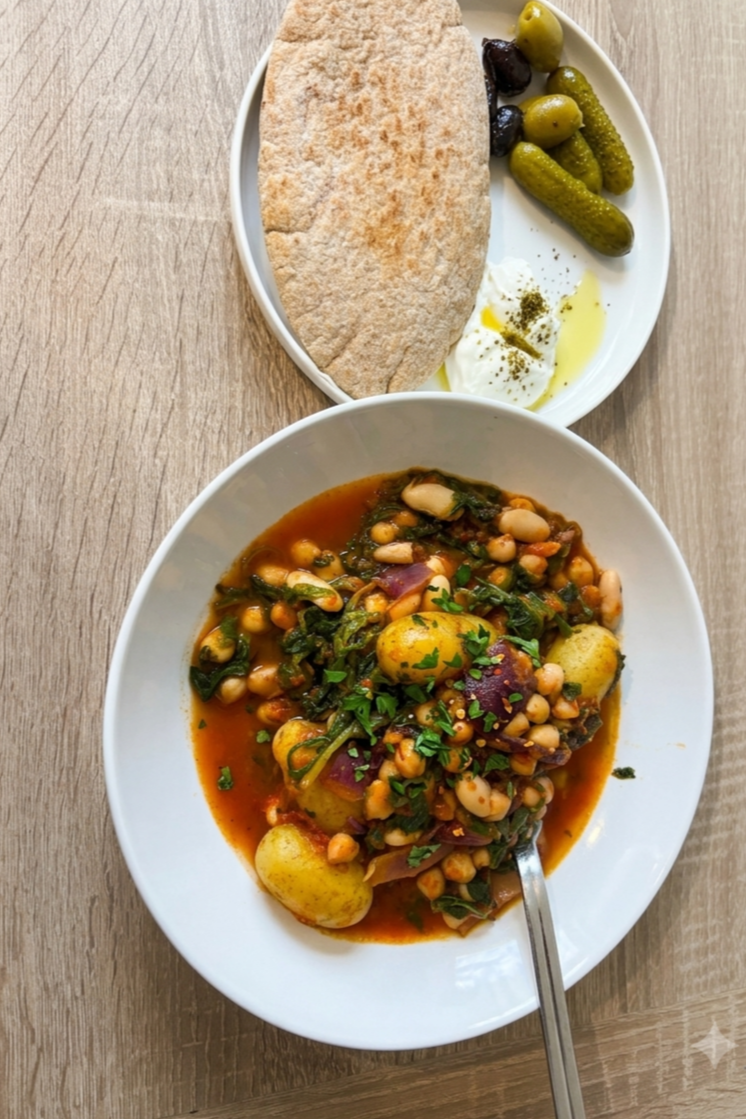
It is how we have always cooked, going back further than anyone remembers. And it is how I cooked myself, years ago, when my children were young and I was feeding a full house every night. Then cooking became less necessary, and the habit of eating became less about pleasure and more about convenience.
That small change, from a table to a tray, from an occasion to a refuelling, is a tiny version of something much larger that has happened to most of us. And it is, I have come to think, the real thing the Blue Zones have to teach us. Not what to eat. How we have stopped living.
I have been reminded of all this because I recently started watching Live to 100: Secrets of the Blue Zones, the Netflix series, for the second time. You may have seen it. In case you haven't, the Blue Zones are five places around the world where people live unusually long and well: Okinawa in Japan, Sardinia in Italy, Nicoya in Costa Rica, Loma Linda in California, and Ikaria in Greece. One of them, Ikaria, is Greek, the world my own family came from.
Watch the series and you keep waiting for the secret to be the food. It never quite is.
What the Blue Zones actually share
What the Blue Zones have in common is not mainly a diet. It is a way of living, built on purpose, family and belonging. Of the handful of things these places share, only a couple concern food. The rest concern people. They move through the day without calling it exercise. They keep a reason to get up in the morning. They put family at the centre of everything, elders living among their children and grandchildren, valued rather than set to one side. And near the top of every list is belonging: a faith, a village, a group that gathers them regularly and holds them inside something larger than themselves.
Dan Buettner, whose research the series is built on, breaks it into nine parts, and the ones he puts at the top are not about food at all. They are community, faith and a sense of purpose.
What is ikigai?
Ikigai is a Japanese word for a reason to get up in the morning. That is the whole of it. It is almost always explained wrong, so it is worth being plain: ikigai is not a career, and not a grand purpose you must discover and then earn a living from. It is simply your reason to get up. In Okinawa it is rarely a job. It is a person to care for, a garden to tend, a table to cook for. Most often, it is something that involves other people needing you. (If you have seen ikigai drawn as a four-circle diagram about passion and paycheques, set that aside. That version was invented in the West and welded onto a word it never belonged to.)
Which is the point hiding inside the whole Blue Zones story. Purpose and belonging are not really two separate things. A reason to get up, more often than not, is other people.
A day in a Blue Zone
Picture an ordinary day in one of these places, because the detail is the whole point.
In Okinawa, people belong to a moai: a small group of friends, sometimes formed in childhood, who commit to one another for life. They meet regularly, share news, and turn up for each other through every trouble and celebration for decades. It is not an app or a club you sign up to. It is simply who your people are, and it never disbands.
In Sardinia, the men who live longer than almost any men on earth spend their later years gathering in the town square, talking and arguing and laughing for hours. In Ikaria, the elderly are not put quietly out of the way. They stay woven into daily life, contributing to the family, dropping in on neighbours, turning up at the festivals and church gatherings that fill the calendar. When there is food left over from a religious holiday, it goes to whoever needs it. Hospitality there has a name, filoxenia, and it is a way of life, not a courtesy. In Nicoya, life is organised around the extended family and the fiesta, and no one is expected to withdraw from the world at sixty, or seventy, or ever.
I recognise all of this, because I grew up around it. My family are from Cyprus, and the Greeks are often called lazy, the cafes full day and night, the long unhurried lunch, life visibly organised around company rather than work. Schools still close at midday. Nobody eats at their desk. And it is easy, from a British vantage point of packed lunches and back-to-back meetings, to see all that sitting and talking as time wasted.
But watch the Blue Zones and you start to wonder who has it wrong. What looks like idleness is community, kept up daily, the thing every one of these long-lived places has and most of us have quietly lost. The full cafe is not a failure of productivity. It is the very thing we are now told, by researchers with data, that we need.
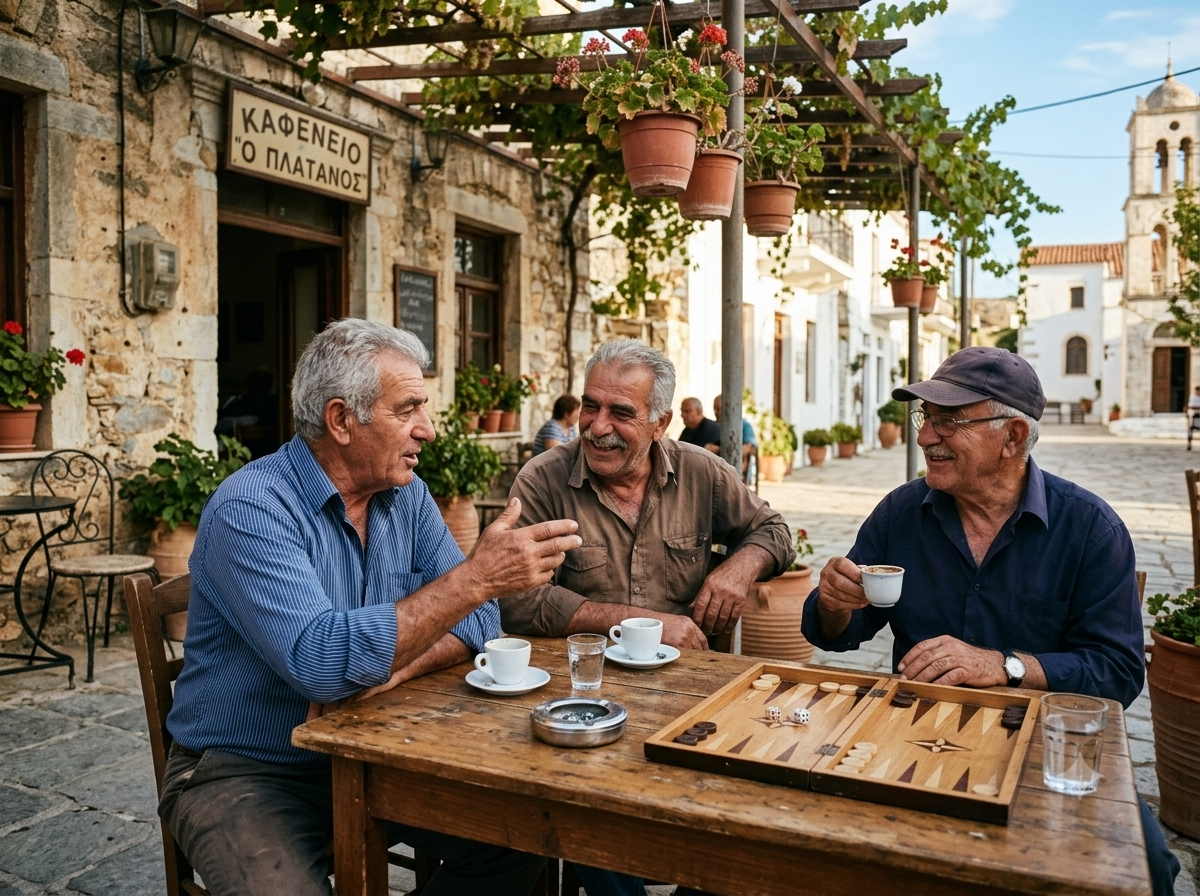
Notice what none of these people have to do. They do not have to schedule their friendships, or drive an hour to see anyone, or wonder whether they are imposing. The community is built into the place itself: the homes close together, the square, the church, the shared table. It is the water they swim in. They could not become isolated if they tried.
What we actually lost
Now picture an ordinary day here.
You wake in a house where you live alone, or nearly. The people you love most are an hour away, or a flight away, scattered by the same opportunity that shaped your working life. You do most of the day's business through a screen. You might exchange more words with a delivery driver than with a friend. The neighbours are pleasant and unknown. And the things that used to gather people without anyone arranging them, the parish, the extended family under one roof, the high street where you ran into people, the workplace that was also a social world, have thinned or disappeared.
None of this is a personal failing, though it is almost always felt as one. It is what modern life is built to produce. We arranged our lives around efficiency and independence, and we got both. What we did not notice we were trading away was the built-in community that every generation before us could take for granted. Nobody dismantled it on purpose. It simply was not designed back in.
And it is felt most sharply after fifty, when the last of the scaffolding comes down at once. The job ends. The children leave. A marriage ends, or a partner dies. The diary that was always full becomes your own to fill, and you find that the people you assumed would always be around now have to be sought out and kept, by an effort no one ever taught you to make.
This is why loneliness has become one of the biggest issues facing people over fifty, and one we rarely say out loud. Not because we are worse at friendship than our grandparents were. Because the world stopped building the connection in.
The Blue Zones did not solve loneliness. They simply never created it. They kept the thing the rest of us took apart.
Even Okinawa is losing it
You can watch this happening in real time, in the most famous Blue Zone of all.
The old Okinawans who made the island a byword for long life grew up inside the whole way of living: the traditional food, yes, but also the moai they belonged to for life, the purpose that kept them needed, the meals made slowly and eaten together. Their grandchildren have inherited something different. After the war, the American bases brought fast food and a car in every drive, and the young abandoned the old table for the drive-through. Today Okinawa has the highest obesity rate in Japan, and, according to the demographers who have tracked its prefectural health data since 1980, its life expectancy, once the highest on earth, has fallen to near the bottom of the country. It is the only prefecture in Japan where it has gone backwards.
It is tempting to blame the food, and the food is certainly part of it. But look closer and it is the whole way of life that has come apart. The shared meal became a solitary one. The slow preparation became a wrapper. The moai thinned. The tight, walkable village gave way to the car and the screen. The diet is the most visible loss because you can see it on a plate, but it travelled together with everything else, the community, the purpose, the ritual of sitting down as a group. They did not lose one ingredient. They lost the life the ingredients were part of.
Which is the whole point. The Blue Zone was never a formula you could isolate and copy. It was a way of living, held together, and when modern life pulled it apart in Okinawa, the famous longevity went with it. What is happening there is only a faster, sharper version of what has already happened to the rest of us.
Why an app won't fix it
The usual answers do not touch this. Download something. Scroll a feed. Join a group where thousands post and no one connects. But endless content is not the same as belonging, and a feed of strangers, however busy, is not a community. The difference is not whether it happens on a screen. It is whether the same people return, over time, until they know you, until there is some history between you, until you are missed when you are not there. A feed can't do that, because a feed isn't built to. But a small, steady group of people who keep showing up for each other can, wherever they happen to meet.
Which is the hard part underneath all of it. Almost everything the Blue Zones teach, you can do on your own. You can cook properly again. You can walk, rest, and find your own reason to get up. But belonging is the one thing you cannot do by yourself, because by definition it takes other people. It is the single part of the Blue Zone life that cannot be a private project, and it is the part that matters most.
Why I am building something
That is why, after years of writing about meaning and freedom in later life, I have started building a community. A deliberate one, for people over fifty who feel the absence of the thing our grandparents never had to think about, and who want somewhere real to belong.
Not a feed to scroll or a group that fades after a fortnight. A place where the same people return, week after week, until they are no longer strangers. Where you are known over time. Where there is somewhere to bring what you are thinking about, and people who will still be there next month to carry it on with you. The thing modern life took out, put back on purpose.
I don't think you can hand someone a village. But I think you can build a place where one has room to grow, and I think a great many of us are ready for it. Because if the Blue Zones prove anything, once you clear away the olive oil and the headlines about living to a hundred, it is this. We were never meant to do life alone. And belonging, unlike so much else, is not a matter of luck or birth. It can be built. That is what I am doing, and I would like you to be part of it.
The Community
I am building a place for exactly this: connection and belonging in the second half of life, for people who take the question of a good later life seriously. Founding membership is open now, at £14 a month, locked at that rate for life. Once the founding places are gone, membership will be £19.