What Does It Actually Mean to Live in the Moment?
— What does it actually mean to live in the moment and why it is so important, yet so difficult to do.
"Live in the moment" may be the most repeated advice of our age. It is on mugs, in captions, at the end of eulogies. I spent years teaching mindfulness, and even in those rooms, perhaps especially in those rooms, the phrase was more often admired than understood. Everyone agreed it was important. Almost no one could say what it actually asked of them.
So let me answer the question plainly, because it deserves a plain answer.
To live in the moment is to be where you actually are. Not as a mood of appreciation, not merely a technique for noticing your tea, but as a decision to stop arguing with the life in front of you. In practice it means noticing your thoughts, recognising that they are just thoughts, not verdicts, and letting them pass. Not upgrading them into better ones. Not brushing them aside as though they were nothing. Noticing, and letting go. It has almost nothing to do with enjoying the pleasant parts. It has everything to do with staying: being where you are, as things actually are, including when you would rather be anywhere else. That is the whole of it. And it is precisely why the advice is so easy to give and so hard to follow.
To see why, you have to start with what the alternative looks like. Because the opposite of living in the moment is not distraction. It is something more organised than that.
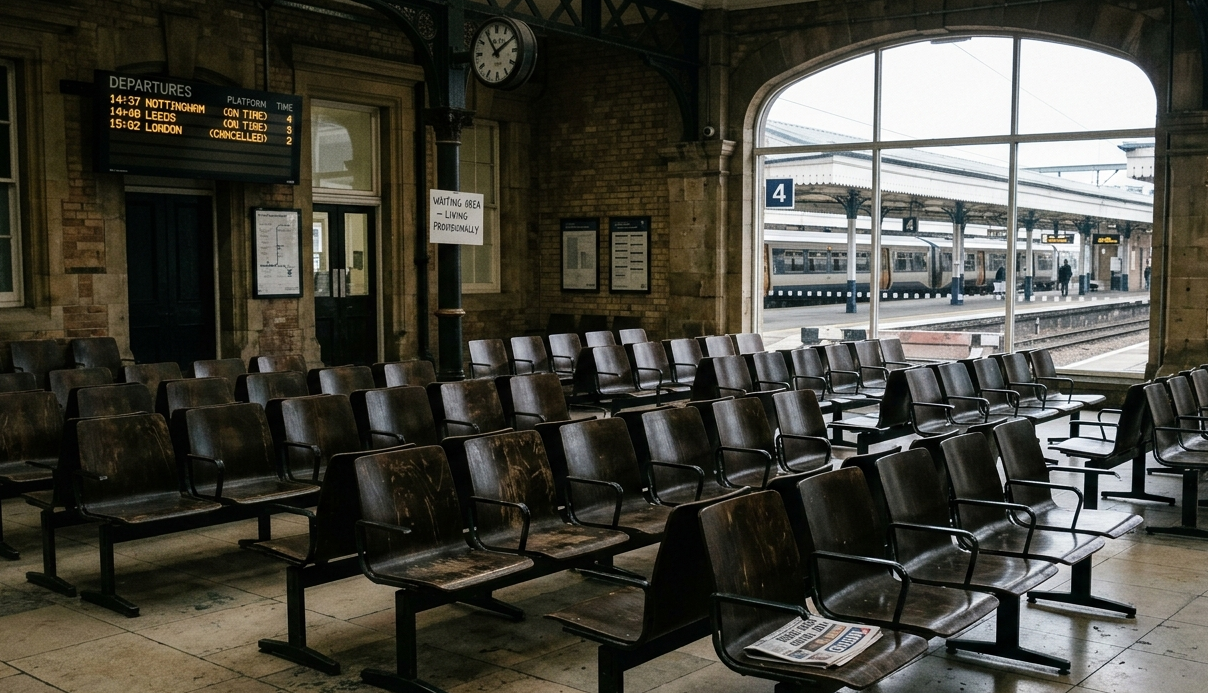
The waiting room
Nobody decides to live provisionally. It happens through small deferrals, each one reasonable on its own, which only form a pattern when you step back far enough to see it. Get through this week. Endure this job. Hold on until the circumstances change. And the one that runs deepest for many of us: wait for the right person to arrive, because somewhere along the way we absorbed the idea that a life unshared has not properly started. Each deferral makes sense. Together they add up to years spent in the waiting room of your own existence — present in the building, absent from the life.
Most of us know this arrangement from the inside. We are somewhere, doing something, and underneath it runs a commentary: this is not the real part. The real part comes later: after the retirement, after the move, after the circumstances finally cooperate. In the meantime, we are getting through.
There is a version of this that only makes sense if you assume the years are unlimited. Endure now, live later. The arithmetic works, provided time keeps arriving.
Why it matters more after 50
That assumption has an expiry date, and most of us pass it somewhere in our fifties.
Time stops feeling like a resource that will keep arriving. It is one of the least discussed shifts of this stage of life and one of the most consequential: the years ahead, while not necessarily short, become countable. And once you know the years are finite, the arithmetic of the waiting room becomes unbearable. Every year spent somewhere you are not is no longer a year deferred. It is a year gone.
This is why living in the moment is not the same advice at 55 as it was at 30. At 30 it is a nice idea. After 50 it is the only honest response to the facts. The moment is not one of several places a life can happen. It is the only place a life has ever happened. Everything else, the past you revisit and the future you are waiting for, is happening in your head, now, while the actual now goes unattended.
I say all this as someone who still fails at it regularly, which is what qualifies me to write about it.
Aiming for something, somewhere

I should say where I speak from, because it is not from above the problem.
I have always been someone who aims. A goal on the horizon, a plan for reaching it, the next thing already taking shape before the current thing is finished. I am like that now: building, with targets and a clear idea of where it is all meant to arrive. And there is nothing wrong with that. Aiming is how anything gets built. Nobody grows, changes their life, or makes anything worth having without looking forward and stretching toward it.
The trouble is not the aiming. The trouble is when aiming becomes the default position, when the horizon is where you permanently live. Because from the horizon, the now looks small. Today becomes a step, valuable only for what it leads to. The goal will be significant; this Tuesday is merely in the way. A life can pass like that, each day spent as currency for a day that never quite arrives.
What taught me the difference, in the end, was the writing itself. My best work does not happen when I am trying to finish, or reaching for the next step, or thinking about where a piece will go once it is done. It happens when I am completely engrossed in the moment: inside the sentence I am writing, with no part of me anywhere else. The moment I start writing in order to have written, the work goes flat. Presence, it turns out, is not only where life happens. It is where the good work happens too.
But knowing this and living it are different things. If knowing were enough, I would be immune by now. Nobody is immune. The difficulty is not a failure of information. It lives somewhere else.
The argument with the room
Here is where it lives.
What removes you from a room is not the room. It is the argument you are having with it.
This is the mechanism, and once you see it you see it everywhere. We think circumstances remove us from our lives: the tedious job, the difficult season, the life that was not the plan. They don't. The removal is done by the resistance, the constant silent argument with what is. And that argument is exhausting in a particular way, because it asks you to fight something that already exists.
Put the argument down and something unexpected happens. You are not more resigned, or more detached. You are there — properly, sometimes for the first time. The room has not changed. What has changed is that you are finally in it. Refusing the resentment is not a way of leaving the moment. It is the only way into it.
Noticing, not fixing
It is worth being precise about what putting the argument down involves, because this is where the teaching of mindfulness so often goes wrong, in two opposite directions.
You do not put a thought down by improving it. Replacing the negative thought with a positive one, reframing it, brightening it, thinking better thoughts: none of that is presence. It is redecoration. You are still in the argument; you have simply changed sides.
And you do not put a thought down by dismissing it either. Waving it away as noise, brushing the feeling off as nothing: that is suppression, and what is suppressed does not go away. It waits.
What actually works is simpler than both, and stranger. You notice the thought. You recognise it as a thought, an event in the mind rather than a verdict on your life. And you let it go, the way you let a train pass through a station without boarding it. The thought is real. You are not required to ride it.
That is all presence is, mechanically. Not the manufacture of better mental content. Not the silencing of the mind; the mind will not be silenced, and the attempt is exhausting. Just the noticing, the recognising, and the releasing, over and over. Owning the now in its rawest form, ugly thoughts, resentment, fear and all, without polishing it and without pretending it away.
The now is not the trap
Here is the strangest part of the whole arrangement.
Living in the past and living for the future both feel like freedom. Going back over what happened feels like loyalty to it. The plan feels like escape from what is. And the present, meanwhile, feels like the trap: the waiting room, the stretch to be got through on the way to somewhere better.
It is exactly backwards.
Regret keeps you serving a sentence for things that can no longer be altered. The marriage you stayed in. The apology that never came. The decision you would give anything to remake. None of it can be remade. And the plan for the future, when it becomes the place you actually live, is not escape. It is more waiting. Between them, the past you keep going over and the future you keep waiting for use up the one freedom you actually have, which is what you do with today.
Because the now is not where you are trapped. It is the only place you have ever had any say. Peace with the past is not made back then, in the year it all happened. It is made now, in how you decide to hold it. And the future is not built in the future. It is built now, or not at all. Every real decision you will ever make, whether to forgive, to begin, or to change something, can only be made in a present moment. There is nowhere else for it to happen.
Both the past and the future deserve space in a life. What they do not deserve is to replace the only thing that is truly present, which is the now.
That, more than any change of circumstances, is what finding freedom in later life actually means.
Not a fair-weather practice
This is what the mugs and the captions get wrong.
We tend to think of living in the moment as something available in good weather. The cup of tea, the walk, the view. But nobody struggles to be present for the parts of life they enjoy. If presence only worked in pleasant conditions, it would be a decoration, not a practice.
The daily habits have real value, and I have written about five practical mindful habits that build the capacity for presence, but they are the training, not the thing itself.
Presence is not the reward you receive when conditions improve. It is a decision available in exactly the conditions you would rather escape — and that is the only place it is worth anything. The people I taught who were living with cancer understood this better than anyone in any room I have ever stood in. They were not being mindful of pleasant moments. They were learning to be present to the life they actually had, because they had understood, before the rest of us, that there was no other life on offer.
That is what it actually means. Not enjoying the moment. Staying in it.
The test
If you want to know whether you are living in the moment or waiting inside your life, here is a lens that cuts through most of the fog.
If the plan for your life only makes sense on the day the circumstances change, the plan is wrong.
The circumstances may well change. But a plan that requires you to be absent until then has already conceded the years in between. Run the test on your own arrangements. The job you are enduring, the season you are getting through, the stretch you have mentally fast-forwarded. Ask of each one: does my way of living this only work if I treat it as an interval? If the answer is yes, the task is not to escape the circumstances faster. It is to withdraw from the argument with them: to be, deliberately and against all habit, where you actually are.
What the deferred things actually are
I will end with the part I keep having to relearn.
The things we postpone until the conditions are right, the health, the friendships, the ordinary attention we give to a Tuesday, are not the reward for the real life finally arriving. They are what a real life is made of. There is nothing else it could be made of.
The moment was never the obstacle between you and your life. It was the life. It is the life now, in whatever room you are reading this, whatever argument you are having with it. And every moment of it is borrowed time. It always was. The difference now is that we can no longer pretend otherwise, and what remains is more precious for it. The most radical thing available to any of us, at any age but especially past the point where the years became countable, is to put the argument down and turn up.
If you want somewhere to begin
Presence is a decision, but decisions are easier with some practice behind them. I have put five of the practices I taught, the ones that held up in the hardest rooms, into a short free guide, 5 Daily Practices for a Calmer Later Life. Not a programme, not a routine to perfect. Five habits worth keeping. Download it free here.