Panic Energy in Later Life: When Fear Becomes the Default
Understanding panic energy, fear, and choice in later life
Have you ever noticed how some periods in life flow effortlessly whilst others feel like pushing a boulder uphill? You’re doing everything right, yet nothing seems to work. Simple decisions feel overwhelming. Rest feels impossible.
If you’re growing older and life feels harder than it should, you’re not imagining it. And you’re not failing.
There’s an invisible force at work, one that affects how clearly you think, how much energy you have, and whether opportunities seem to appear or disappear.
I call it panic energy, and it’s more common in later life than most people realise.
When the Retirement Story Breaks Down
For many people in later life, this shift happens when the traditional narrative stops making sense.
Maybe your finances didn’t unfold as planned. Maybe relationships changed or ended. Maybe health introduced limitations you never anticipated. Maybe you’re facing real concerns about security, even homelessness.
When the story you’ve been following no longer works, fear quietly moves to the centre of everything.
Fear of running out of time. Fear of running out of money. Fear of becoming invisible, irrelevant, or dependent.
And when fear takes over, it doesn’t stay in one corner of your life. It becomes the energy you operate from every single day.
What Panic Energy Actually Looks Like
Panic energy isn’t the dramatic kind we typically picture. It’s subtler, more persistent, and often mistaken for something else entirely.
You might recognise it as a constant sense of urgency, even when nothing urgent is happening. Or it could present itself as an inability to make decisions or take action, burying your head rather than looking at the problem.
From the outside, this can look like responsibility or dedication. On the inside, it feels like your nervous system never gets to turn off.
Panic energy is fear energy, and it’s exhausting.
How Fear Rewires Your Experience of Life
When we live in chronic fear, the body responds as though under constant threat. This isn’t a malfunction; it’s biology doing exactly what it’s designed to do.
Bruce Lipton’s research in epigenetics demonstrates this beautifully: when the body perceives threat, it shifts from growth mode to protection mode. The same cells cannot be in both states simultaneously.
But here’s what happens when fear becomes your baseline:
Energy gets redirected from growth, repair, and creativity towards protection and survival. Your thinking narrows. Possibilities become harder to see. Your body feels tense and tired at the same time.
Life begins to feel resistant, as though you’re constantly working against an invisible force.
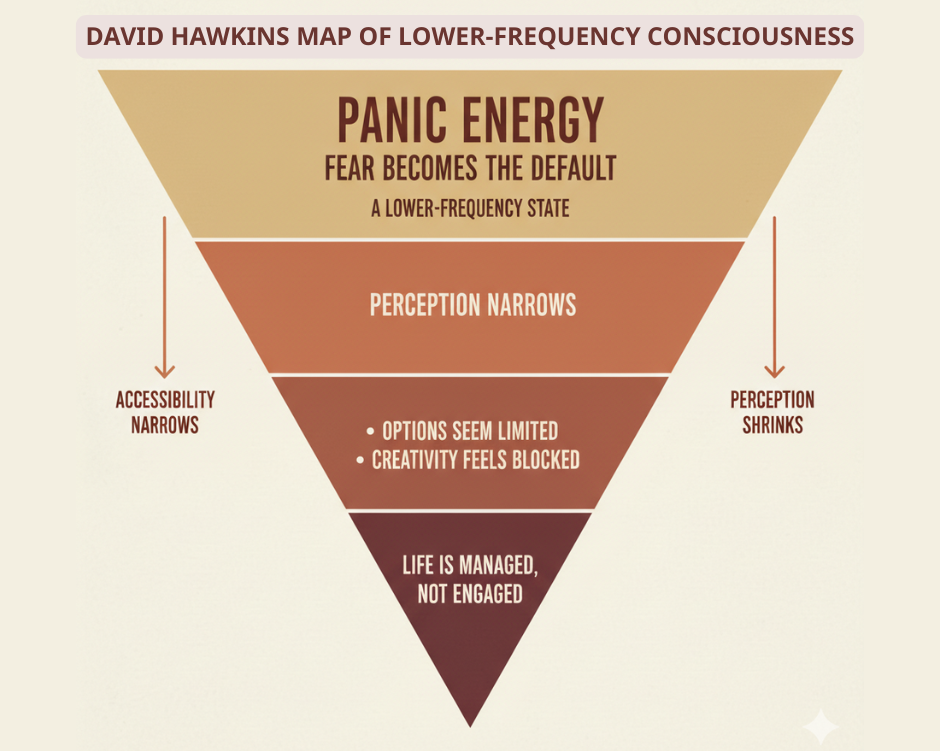
David Hawkins, in his consciousness research, mapped this as a lower-frequency state. Not lower in value, but lower in what becomes accessible to you:
Your perception narrows
Options seem limited
Creativity feels blocked
Life becomes something to manage rather than engage with
The outer circumstances might not change much. But the inner state changes everything.
Why “Just Do More” Stops Working
Here’s the paradox of panic energy: the more you push, the more stuck you feel.
You’re busy. Active. Constantly doing. Yet nothing seems to move forward.
This is because fear contracts energy rather than expanding it. Energy wants to flow, but fear creates blockages. It turns energy inwards, where it becomes trapped.
This is why people operating from panic energy often say:
“I feel stuck, no matter what I try”
“Nothing seems to work anymore”
“I can’t see a way forward”
They’re not being dramatic. They’re describing an energetic reality.
The Buddhist Perspective: Why Fear Creates Suffering
Buddhist teachings offer a useful framework here. Suffering arises when the mind grasps for certainty in an inherently uncertain world.
Fear tightens the body. Urgency agitates the mind. Awareness shrinks to a pinpoint focused only on threat.
Mindfulness practices aren’t about forcing calm or pretending everything is fine. They’re about changing the quality of your attention so that fear loosens its grip and energy can move again.
When awareness expands, even slightly, the panic begins to release.
Why Later Life Makes This Worse (And Better)
Later life brings questions into sharp focus — questions about meaning, purpose, and what you’re willing to accept versus what you’re no longer willing to tolerate.
Carl Jung wrote extensively about the second half of life as a time when the psyche demands something different from us. The ego’s agenda (achievement, acquisition, external validation) begins to feel hollow. Yet panic energy keeps us clinging to what Jung called the provisional life, the life we constructed to meet others’ expectations rather than our own soul’s calling.
Panic energy thrives when change feels too dangerous. When the known, however uncomfortable, seems safer than the unknown.
Fear whispers:
Don’t rock the boat at your age
It’s too late to start over
Better to keep what you have than risk losing everything
So you stay in jobs that drain you, relationships that no longer fit, lives that feel smaller than they need to be.
Not because you want to, but because panic energy has convinced you that change is the real threat.
But here’s what’s also true: later life offers something younger years don’t. The earned wisdom to recognise when fear is running the show. Jung understood this as the potential of the second half of life: not decline, but individuation. The chance to become who you actually are, rather than who you thought you should be.
Intentional Ageing: Choosing Your Energy
This isn’t about slowing down or speeding up. It’s about changing the energy you live from.
Panic energy keeps you tied to the familiar, not because it serves you, but because it feels safer than uncertainty.
When fear dominates, you choose safety over truth. Certainty over desire. Predictability over aliveness.
Intentional ageing begins when you notice this pattern and question it honestly:
What am I staying in because it’s genuinely right — and what am I staying in because I’m afraid to leave?
This isn’t about being reckless or impulsive. It’s about being honest.
When panic energy loosens, even slightly, something shifts. You don’t necessarily move faster or slower. You move more truthfully.
What Changes When Fear Releases
When you’re no longer operating from panic energy:
Decisions come from clarity rather than urgency
Rest feels nourishing rather than dangerous
Possibilities become visible that were hidden before
Energy flows rather than stagnates
Life feels lighter, even when circumstances remain challenging
This isn’t magical thinking. It’s what becomes available when your nervous system isn’t constantly braced for disaster.
Hawkins’ research showed that consciousness itself calibrates differently at various emotional states. Fear calibrates at 100 on his scale, whilst courage calibrates at 200. This marks a threshold where life stops feeling like something happening to you and starts feeling like something you can engage with creatively.
Lipton’s work confirms this at the cellular level: when we shift out of protection mode, the body’s intelligence can focus on growth, healing, and adaptation rather than mere survival.
Moving Forward: From Panic to Presence
If you recognise panic energy in yourself, know this: you’re not broken. You’re responding to real uncertainty in a world that offers few guarantees.
But fear doesn’t have to be your default state.
Energy responds to awareness. And awareness, brought with kindness rather than judgement, creates space for change.
Even in later life — perhaps especially in later life — another way of living remains possible.
The question isn’t whether you have enough time or resources. The question is: what becomes available when you stop living from fear?
If you’re ready to explore what life could look like beyond panic energy, I’m creating a new resource to help you navigate these challenges. Join the waitlist here to be the first to know when it’s available.
What’s one area of your life where panic energy might be running the show? I’d love to hear your thoughts in the comments below.
If this article resonated with you, you might also enjoy: